
Structural Audit Services in
Mumbai, Navi Mumbai & Thane
A Structural Audit is a comprehensive assessment of a building to evaluate its structural safety, strength, stability, durability, and overall condition. It helps identify structural defects and signs of deterioration such as cracks, corrosion, concrete spalling, water seepage, deflection, and other structural distress.
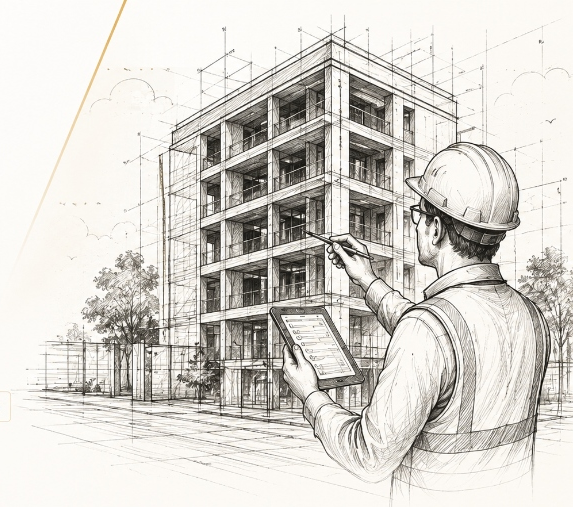
About Structural Audit
A professional structural audit helps building owners and housing societies understand the present condition of their property and determine the need for repairs, rehabilitation, structural strengthening, waterproofing, retrofitting, and preventive maintenance.
Nirman Projects Consultant provides professional Structural Audit Services in Mumbai, Navi Mumbai, Thane, Kalyan-Dombivli, and Mira-Bhayandar, helping housing societies and property owners make informed decisions about the safety, maintenance, and long-term performance of their buildings.
Our Audit Process
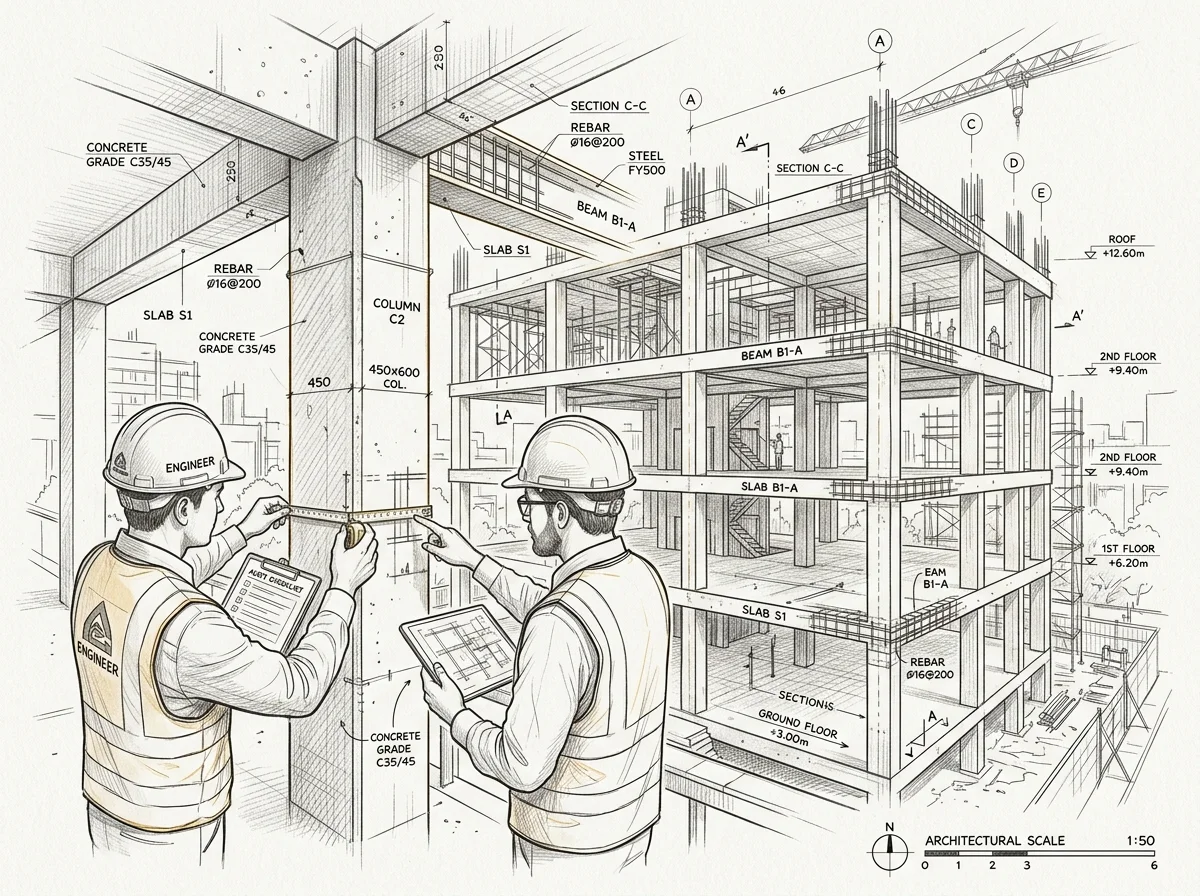
Preliminary Inspection
Visual inspection of the structure, surroundings and distress signs.
Detailed Assessment
In-depth testing, NDT investigation and evaluation of structural elements.
Analysis & Reporting
Identifying root causes and preparing a comprehensive audit report.
Recommendations
Providing solutions and guidance for repairs, rehabilitation or strengthening.
Why is Structural Audit Important?
Buildings can deteriorate over time due to ageing, water seepage, corrosion, environmental exposure, inadequate maintenance, unauthorized alterations, and other factors. A structural audit helps identify such issues and determine appropriate corrective measures.
Occupant & Property Safety
Ensure the safety of occupants and property.
Assess Present Condition
Assess the present condition of the building.
Identify Critical Defects
Identify critical structural defects requiring attention.
Detect Deterioration Signs
Detect cracks, corrosion, spalling, seepage & deflection.
Repair Recommendations
Recommend suitable repair and maintenance measures.
Improve Durability & Life
Improve the building's durability and service life.
Rehabilitation Planning
Help housing societies plan rehabilitation works.
Statutory Compliance
Support compliance with applicable statutory requirements.
Structural Audit for Housing Societies (Bye-Law No. 77)
Structural audits are particularly important for ageing residential buildings and co-operative housing societies.
As per Bye-Law No. 77 of the applicable Maharashtra Co-operative Housing Society Bye-Laws, structural audits are generally required at the following intervals:
- Buildings aged 15–30 years: Once every 5 years.
- Buildings aged above 30 years: Once every 3 years.
* Note: The exact applicability should be verified against the current applicable bye-laws and statutory requirements for the specific society or building.
What Does Our Structural Audit Include?
Our building structural audit involves a systematic inspection of structural elements, common areas, and other relevant parts of the property.
Inspection of Structural Elements
Inspection of accessible:
- Columns, Beams & Slabs
- Staircases & Balconies
- Chajjas & structural members
Identifies cracks, corrosion, spalling, deflection & distress.
Flat-Wise Condition Survey
Where required, a flat-wise condition survey is carried out to identify defects within individual flats and areas that may require further investigation or corrective action.
Leakages & Waterproofing Defects
Assessment of:
- Terraces, WC & Bathrooms
- Kitchens & Plumbing areas
- Passages & Common areas
Identifies leakage, drainage issues & waterproofing defects.
Thermal Imaging / Testing
Advanced camera scanning to detect:
- Hidden water leakage & internal seepage
- Trapped moisture behind walls & tiles
- Concealed dampness without breaking plaster
Common Area Inspection
Assessment of accessible:
- Balconies, Lift shafts & Ducts
- Staircases, Passages & Terraces
- Common building amenities
Unauthorized Structural Changes
Checking for harmful modifications like:
- Breaking load-bearing walls, columns & beams
- Illegal flat extensions & heavy extra loads
- Modifications that risk building safety & strength
Water & Vegetation Defects
Audit of defects associated with:
- Water leakage & Drainage issues
- Persistent dampness
- Vegetation & peepal growth
Repair Recommendations
Suitable recommendations provided for:
- Structural Repairs & Rehabilitation
- Structural Strengthening, Retrofitting & Waterproofing
- Preventive Maintenance & Safety Measures
NDT (Non-Destructive Testing) Methods
Non-Destructive Testing (NDT) comprises techniques used to assess the condition and certain properties of structural materials and members without causing significant damage to the building.
NDT can help identify hidden defects, investigate deterioration, assess concrete and reinforcement-related conditions, and support structural audit and repair recommendations.
Ultrasonic Pulse Velocity (UPV) Test
Evaluates concrete quality, homogeneity and detects internal cracks.
Rebound Hammer Test
Measures surface hardness and estimates concrete compressive strength.
Carbonation Test
Determines carbonation depth and risk of reinforcement corrosion.
Half-Cell Potential Test
Assesses probability and active rate of steel rebar corrosion.
Concrete Chemical Analysis
Tests chloride and sulphate content in concrete samples.
Cover Meter Survey
Accurately measures rebar location, spacing and concrete cover thickness.
Core Test
Extracts concrete core samples for direct laboratory compressive strength testing.
Thermal Camera Test
Detects hidden dampness, seepage pathways and moisture accumulation.
* Note: The appropriate testing method depends on the condition of the building, observed defects, and technical investigation requirements.
Structural Audit Services in Mumbai & Nearby Cities
Nirman Projects Consultant provides professional structural audit and building assessment services across key locations in the Mumbai Metropolitan Region, including:
Our services are intended for housing societies, residential buildings, property owners, and other building stakeholders who require professional assessment of their building's structural condition.
Frequently Asked Questions on Structural Audit
Here are clear, authoritative answers to the most common questions housing society management committees, flat owners, and property managers ask regarding building structural audits, statutory mandates, NDT tests, and repair roadmaps:
Under Section 353B of the Mumbai Municipal Corporation (MMC) Act, Bye-Law No. 77 of the Maharashtra Co-operative Housing Societies Act, and statutory directives by local civic bodies (MCGM/BMC, TMC, NMMC, KDMC, and MBMC), structural audits are legally mandated as follows:
- Buildings aged 15 to 30 years: Mandatory once every 5 years.
- Buildings aged above 30 years: Mandatory once every 3 years.
The audit must be conducted by a registered and licensed Structural Engineer who submits the formal audit report and Form 'B' compliance certificate to the municipal corporation.
Municipal authorities and structural engineers classify audited structures into four standardized categories based on safety and structural integrity:
- C1 (Extremely Dangerous / Unfit for Habitation): Structural collapse imminent; requires immediate evacuation and demolition.
- C2-A (Major Structural Repairs with Partial Evacuation): Severe structural distress in columns/beams/slabs requiring critical structural retrofitting/jacketing with temporary evacuation of specified flats or floors.
- C2-B (Major Structural Repairs without Evacuation): Substantial structural repairs required to beams, slabs, and columns, but works can be executed safely while residents continue living in the building.
- C3 (Minor Repairs Only): Structure is sound; requires standard maintenance like external plastering, terrace waterproofing, plumbing rehabilitation, and painting.
Our comprehensive, municipal-compliant Structural Audit Dossier includes:
- Visual Distress Mapping: Detailed photo-documentation of cracks, rebar exposure, spalling, deflection, and dampness.
- NDT Test Results & Laboratory Analysis: Numerical data on concrete strength, corrosion rates, carbonation depths, and ultrasonic velocity.
- Structural Stability Assessment: Quantitative condition evaluation of all RCC columns, beams, slabs, shear walls, and chajjas.
- Categorization (C1 / C2-A / C2-B / C3): Formal grade assigned as per municipal standards.
- Prioritized Repair & Rehabilitation Roadmap: Step-by-step technical methodology for strengthening and waterproofing.
- Bill of Quantities (BOQ) & Cost Estimation: Itemized budget projection for transparent society AGM decision-making.
- Official Structural Stability Certificate: Signed & stamped by our Govt. Registered Structural Engineer.
We deploy calibrated, high-precision non-destructive and semi-destructive testing apparatus depending on the building's age and observed distress:
- Rebound (Schmidt) Hammer Test: Evaluates surface hardness and estimates in-situ concrete compressive strength.
- Ultrasonic Pulse Velocity (UPV) Test: Measures acoustic velocity through concrete to detect internal voids, honeycombing, and deep cracks.
- Half-Cell Potential Meter: Measures electrochemical activity to assess active corrosion risk in internal steel reinforcement.
- Carbonation Test: Phenolphthalein chemical test to determine depth of atmospheric carbonation causing depassivation of steel.
- Core Test: Core cutting for direct hydraulic press compressive strength testing.
- Cover Meter / Rebar Locator Survey: Scans exact rebar spacing, diameter, and remaining concrete cover depth.
- Infrared Thermal Imaging: Maps hidden moisture traps, water ingress paths, and active leakage behind tiles/plaster.
A standard residential society structural audit follows a predictable timeline:
- On-Site Survey & Flat Inspection: 1 to 3 days (depending on number of wings, floors, and flats).
- NDT Testing & Lab Processing: 7 to 10 working days.
- Engineering Analysis & Report Compilation: 3 to 5 working days.
- Total Turnaround Time: The final audit report with BOQ and municipal certificate is delivered within 20 to 25 working days from site completion. Urgent audits can be expedited upon request.
Yes. While external columns and common areas provide vital clues, internal flat inspections are essential because:
- Top-floor flats exhibit terrace seepage, slab degradation, and ceiling reinforcement delamination.
- Lower-floor and ground-floor flats experience maximum column load stresses and dampness from ground level.
- Flats with bathroom/kitchen plumbing leaks cause concealed corrosion in the RCC slab and beams underneath.
- It allows engineers to spot unauthorized structural wall removals or modifications made by flat occupants.
Nirman Projects Consultant provides complete end-to-end guidance to housing societies after the audit report is ready:
- Municipal Compliance: We submit Form 'B' compliance documents and formal representations to BMC / TMC / NMMC / KDMC / MBMC authorities.
- NABL-Accredited Laboratory Testing: All concrete core crushing, chemical analysis, and diagnostic testing are conducted via certified NABL laboratories for 99.9% authentic, municipal-compliant reports.
- AGM Presentation: Our senior structural engineers attend your Society Special General Body Meeting (SGM/AGM) to present technical findings in simple terms and answer members' doubts.
- Tender & BOQ Formulation: We prepare detailed itemized tender documents with exact market rate analysis.
- Project Management Consultancy (PMC): We supervise the actual repair execution, conduct quality checks on materials (polymers, micro-concrete, rebar coatings), and certify contractor billing stage by stage.
With over 10+ years of engineering excellence and more than 150+ successful building rehabilitation projects across Mumbai, Navi Mumbai, Thane, Kalyan-Dombivli, and Mira-Bhayandar, Nirman Projects provides:
- Govt. Registered Structural Engineers with license accreditation across all MMR municipal corporations.
- NABL-Accredited Laboratory Testing & Calibrated NDT Equipment ensuring accurate, certified, and unbiased diagnostic results.
- Transparent, society-first approach — we recommend only necessary, scientifically validated repairs, preventing exaggerated contractor scopes.
- Comprehensive post-audit support from municipal submissions to complete PMC execution oversight.